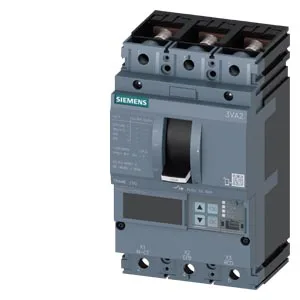
At 415 V and 440 V it still holds 121 kA, and at 500 V it drops to 79 kA; at 690 V the rating falls to 4.25 kA, which means on a 690 V system you need to verify the available fault current is below that threshold. The 20 000 mechanical/electrical endurance cycles (latching) tell you it is rated for a moderate number of operations; not a high-switching-duty breaker like a motor-circuit protector, but fine for feeder protection where it operates a few times a year.
Footprint and panel fit — 86 mm depth, 105 mm width
That 105 mm width is the standard 3-pole MCCB footprint for the 3VA2 frame — it occupies three 35 mm DIN-rail modules (each 35 mm wide) plus the overhang for the rotary handle and arc-chamber vents. The 86 mm depth includes the terminals and the arc-chamber projection; verify clearance behind the panel door for the handle swing and any auxiliary wiring. The operating temperature range is -25 °C to 70 °C, and the current derating curve is published: full 100 A up to 50 °C, then 96.25 A at 55 °C, 92.5 A at 60 °C, 88.75 A at 65 °C, and 85 A at 70 °C. If your panel ambient hits 60 °C, you must load the breaker to no more than 92.5 A continuous. Maximum power loss is 12.5 W — that is the heat the breaker dumps into the enclosure at full rated current. For a multi-breaker panel, sum these losses and check the enclosure's thermal dissipation rating to avoid derating the whole assembly.
Communication and monitoring — ETU850 with measurement functions
The ETU850 trip unit includes a communication function and an 'other measurement function' — that typically means it can report current, power, and energy data over a digital bus (likely PROFIBUS or PROFINET via a communication module, though the specific protocol is not listed here). The trip indicator is present, so after a fault you get a local mechanical flag showing the breaker tripped on overcurrent rather than being manually opened. The voltage trigger is also absent; this is a current-only trip unit.