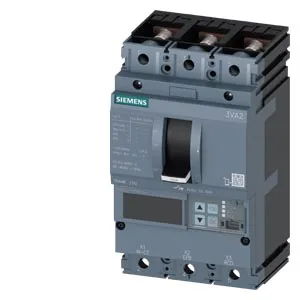
What this MCCB brings to a 480 V panel
It carries a 187 kA interrupting capacity at 240 V and still delivers 121 kA at 415 V and 440 V — enough to handle high-fault scenarios on the secondary side of a distribution transformer without cascading upstream. The line-protection version means it's tuned for feeder and main breaker duty, not motor branch circuits.
The 100 A rating holds flat from 40 °C up to 50 °C, then derates linearly: 96.25 A at 55 °C, 92.5 A at 60 °C, 88.75 A at 65 °C, and 85 A at 70 °C. Operating ambient minimum is -25 °C, maximum 70 °C.
Interrupting capacity across voltage levels
This breaker's interrupting capacity drops as voltage rises: 187 kA at 240 V, 121 kA at 415 V and 440 V, 79 kA at 500 V, and 4.25 kA at 690 V. The 690 V figure is low — fine for a 480 V delta secondary where available fault current rarely exceeds 65 kA, but if you're on a 600 V or 690 V system with high SCCR requirements, this isn't the right frame.
The 105 mm width matches the typical 3-pole MCCB slot in a panelboard or switchboard. The depth of 86 mm means it clears most standard enclosure back-panels with room for wiring gutters.
Trip unit and release details
It also includes a ground-fault alarm or trip function, though this specific variant ships without a ground-fault monitoring module (: Without). The undervoltage release (UVR) is built in — part number 3VA9608-0BB24 for the integrated auxiliary trip. This breaker does not have a separate auxiliary contact block (: Without), so if you need remote status indication, you'll need to add one or use the communication function. The communication function is present (: Yes), so the breaker can report trip status and metering data over the plant network.