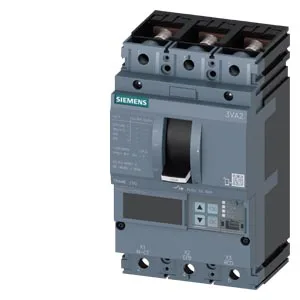
Three poles, 100 A rated continuous current (Iu), and an ETU850 electronic trip unit — that combination tells you it's a microprocessor-based breaker, not a thermal-magnetic, so you can dial in the trip curve to coordinate with downstream devices. The interrupting capacity climbs to 187 kA at 240 V and stays at 121 kA through 440 V; at 690 V it still clears 4.25 kA. That's a lot of fault energy for a 100 A frame, meaning it's sized for high-available-fault panels where a standard MCCB would weld itself shut. Thermal derating is published all the way to 70 °C ambient: it holds 100 A flat from 40 °C to 50 °C, then drops to 96.25 A at 55 °C, 92.5 A at 60 °C, 88.75 A at 65 °C, and 85 A at 70 °C.
The breaker occupies 105 mm width, 181 mm height, and 86 mm depth. The depth matters when you're up against a gland plate or a shallow enclosure door; 86 mm leaves room for cable bends and the undervoltage release module that comes fitted on this variant. Communication function and other measurement functions are present, so this breaker can report status and energy data back to a BMS or PLC without a separate metering module.
What's on the van — field-service perspective
If you're swapping this into an existing panel, the key gotcha is the undervoltage release: it needs a control voltage to hold the breaker closed. No control power means the breaker stays tripped, which is the intended behaviour but can surprise someone who expects a plain thermal-magnetic that stays latched. The ETU850 is programmable via the front keypad or software, so you can adjust long-time, short-time, instantaneous, and ground-fault settings without swapping trip units. The 20 000 mechanical endurance cycles mean it's rated for switching duty, not just backup protection — it'll handle regular load-break operations on a production line.