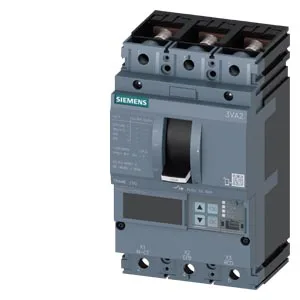
The Siemens SENTRON 3VA2110-5KP32-0DL0 is a 3-pole molded case circuit breaker (MCCB) rated for 100 A continuous current, with an ETU850 electronic trip unit and line protection profile. The 121 kA at 415 V and 79 kA at 500 V keep it viable across common industrial voltage levels.
Trip unit and ratings
The 100 A rating holds flat from 40 °C to 50 °C, then derates linearly to 85 A at 70 °C. Maximum power loss is 12.5 W — modest for this class, but worth factoring into thermal calculations in a dense cabinet. The 4.25 kA at 690 V is the tail-off point — if your fault level at that voltage exceeds that, you need to check coordination upstream.
Footprint is 105 mm wide, 181 mm tall, 86 mm deep — standard for the 3VA2 frame size. It mounts via screw terminals or can be bolted onto a mounting plate; no DIN-rail clip on this frame.
The auxiliary contact block is configured as 2 auxiliary switches + 1 trip alarm switch + 1 electrical alarm switch HQ, giving you status feedback for PLC or SCADA.
Environmental range
Operating temperature spans -25 °C to 70 °C; storage range is -40 °C to 80 °C. The 20 000 mechanical endurance cycles is typical for this class — fine for distribution duty, but if you're switching it daily under load, watch the electrical endurance curve.