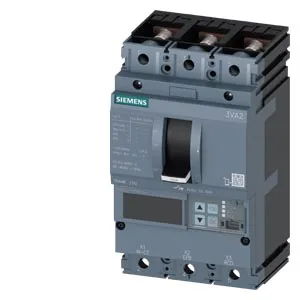
Three poles, so it's for three-phase systems. Breaking capacity is the headline: 187 kA at 240 V AC, 121 kA at 415 V and 440 V, 75.6 kA at 500 V, and still 3.7 kA at 690 V — that covers most industrial distribution voltages without needing a current-limiting fuse upstream.
The 100 A frame is the continuous current rating — the breaker will carry 100 A indefinitely without tripping on thermal overload. The 3.7 kA at 690 V is lower but still adequate for most 690 V motor circuits where fault currents are typically under 10 kA. The breaker includes a trip indicator and voltage trigger, plus a communication function — likely for remote monitoring or integration with a BMS or SCADA system.
Auxiliaries and integration
The shunt trip lets a PLC or safety relay kill power to the load without needing a separate contactor. The auxiliary switches can feed back breaker position (open/closed/tripped) to a control system. No undervoltage release on this unit, so if you need UV protection for motor starting, spec the UVR variant instead.