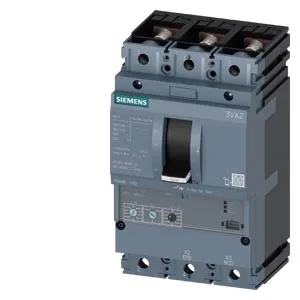
It's designed to protect motor feeders and branch circuits where adjustable overload and short-circuit protection is needed, with phase failure detection built in. The interrupting ratings are serious: 187 kA at 240 V, 121 kA at 415 V and 440 V, 75.6 kA at 500 V, and 17 kA at 690 V. That means it can handle high-fault-current scenarios downstream of large transformers or in industrial distribution without cascading failure — the 187 kA figure at 240 V is the headline number for most US-style 240 V delta or 277/480 V wye panels where the available fault current is high. The thermal derating curve is flat to 50 °C (full 100 A), then drops to 96 A at 55 °C, 94 A at 60 °C, 92 A at 65 °C, and 90 A at 70 °C — useful for panels in hot environments or near heat sources.
What the trip unit means for fit
That's the standard for motor protection where you need coordination with motor starting inrush and selective tripping downstream. The undervoltage release (UVR) is integrated as standard — part number 3VA9608-0BB24 for the auxiliary trip module. Latching endurance is 20,000 operations.
Maximum power loss is 75 W at rated current — account for that in enclosure thermal calculations, especially in a sealed panel with multiple breakers. The undervoltage release provides one form of remote trip capability, but it's not a status output.