What this MCCB brings to a motor branch
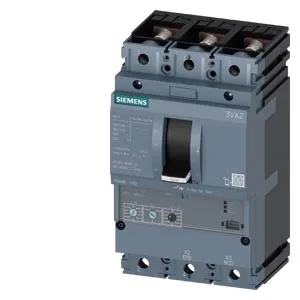
The Siemens 3VA2110-5MN32-0HC0 is a SENTRON molded case circuit breaker (MCCB) built specifically for motor protection — the design of the product is motor protection, and it includes phase failure detection so a lost phase trips the breaker before single-phasing cooks the winding. Rated 100 A continuously across the full ambient range from 40 °C to 70 °C — no derating curve to chase — and it delivers 187 kA interrupting capacity at 240 V, 121 kA at 415/440 V, and still holds 75.6 kA at 500 V. That 187 kA at 240 V means this breaker can sit on the line side of a high-fault panel without needing a current-limiting fuse ahead of it — the SCCR headroom is built in. Three-pole, 86 mm deep by 105 mm wide by 181 mm tall, with a shunt trip (STL) release and two HQ auxiliary switches integrated — the auxiliary switch design is 2 auxiliary switches HQ.
What the ratings mean for panel fit
The 86 mm depth fits standard MCCB panel footprints — no deep-can requirement — and the 105 mm width means it occupies three pole spaces on a DIN-rail or panel-mount backplate. Maximum power loss is 10 W, so heat dissipation inside a sealed enclosure is manageable — no forced cooling needed for a single unit, but stack several in a row and the cumulative loss matters. Operating temperature range is -25 °C to 70 °C, storage from -40 °C to 80 °C — the storage limit governs handling and shipping, not running conditions.
Trip unit and release configuration
The breaker includes a voltage trigger but no undervoltage release, no ground-fault monitoring, and no communication function — it is a standalone thermal-magnetic or electronic trip unit (the supplied basic switch is 3VA21105MN320AA0) with a shunt trip for remote opening. No trip indicator on the front face — the auxiliary switches (2 HQ) provide remote status instead. Short-time delay is adjustable from 4 s minimum to 17 s maximum, which gives selectivity coordination room downstream.
