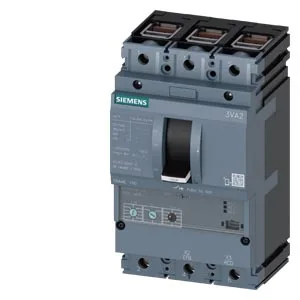
What this 100 A MCCB delivers for motor circuits
The Siemens 3VA2110-5MN36-0JA0 is a SENTRON molded case circuit breaker (MCCB) rated for 100 A continuous current, with a flat thermal derating curve that holds at 100 A from 40 °C all the way to 70 °C — meaning no capacity loss in a warm panel or near a motor starter. The interrupting ratings are substantial: 187 kA at 240 V, 121 kA at 415 V and 440 V, and still 75.6 kA at 500 V, dropping to 3.7 kA at 690 V.
Panel fit and wiring considerations
The 3VA2110-5MN36-0JA0 measures 105 mm wide by 181 mm tall by 86 mm deep — a standard 3-pole MCCB footprint that fits most DIN-rail or panel-mount enclosures without re-drilling. The 86 mm depth (3.39 in) leaves clearance behind the door for wiring ducts or a second row of devices. Maximum power loss is 10 W, which is low enough that adjacent breakers in a multi-unit panel don't require extra spacing at full load, though the flat derating curve already accounts for ambient heat buildup. The shunt trip release operates on a voltage trigger — confirm the control voltage matches your trip-coil rating before wiring; the undervoltage release is not fitted on this variant.
What the flat derating means for cold-chain and warm environments
The 100 A rating holds steady across the full operating ambient range of -25 °C to 70 °C — no derating needed even in a freezer line (-25 °C minimum operating) or a hot compressor room (70 °C maximum). The trip indicator is not fitted on this variant, so visual confirmation of a tripped state relies on the handle position or a remote signal from the shunt trip circuit.