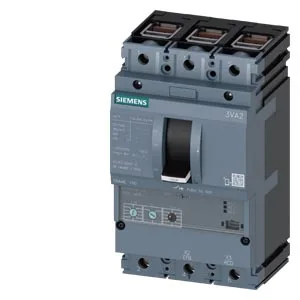
The motor protection design means the trip curve is shaped for overload and phase-loss conditions common to induction motors. No undervoltage release on this variant.
Auxiliary and release configuration
The shunt trip allows remote tripping via a control signal — useful for emergency-stop circuits or interlocking with upstream protection. The auxiliary switches provide status feedback (open/closed/tripped) to a PLC or indication panel. No communication function on this variant — it's a standalone breaker, not a metering or networked unit. If you need remote monitoring beyond the aux contacts, you'd add an external I/O module.
Panel fit and environment
That's a standard SENTRON 3VA2 frame footprint — same width as the 160 A and 250 A frames in the same series, so busbar and mounting hole patterns carry across if you upsize later. Maximum power loss is 10 W — negligible for enclosure heating calculations, but worth noting if you pack multiple breakers in a small sealed box.