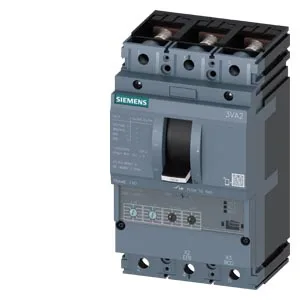
What this MCCB is and what the ratings mean
The Siemens SENTRON 3VA2110-6HN32-0AE0 is a 3-pole molded case circuit breaker (MCCB) rated for 100 A continuous current at 40 °C, with an ETU350 electronic trip unit. It's built for line protection — meaning it sits at the feeder or main distribution point, not on a motor branch. The interrupting ratings tell you where it can go: 242 kA at 240 V AC, 187 kA at 415 V and 440 V, 121 kA at 500 V, and 5 kA at 690 V. That 242 kA figure at 240 V is the one that catches the eye — it's sized for high-fault-capacity panels where the available short-circuit current is well above what a standard 100 A frame would see. The 5 kA at 690 V is a reminder that this is a 600 V-class frame pushed to its upper voltage limit; don't spec it for 690 V distribution expecting the same headroom. The ETU350 trip unit is electronic, not thermal-magnetic, so it gives you adjustable long-time, short-time, and instantaneous pickup settings — that's the kind of curve shaping you need for selective coordination downstream. No undervoltage release, no ground-fault monitoring, no communication module on this variant; it's a straight line-protection breaker with four high-quality auxiliary switches (HQ) for status feedback back to the PLC or panel indicators. The breaker carries a 20 000-cycle latching endurance — that's the mechanical life for the latching mechanism, not the electrical switching life under load. For a main breaker that sees maybe a few operations a year, that's effectively lifetime; for a frequently switched load, you'd want to check the electrical endurance curve.
Thermal derating and panel fit
The 100 A rating holds flat from 40 °C to 50 °C ambient. Above that it steps down: 96.25 A at 55 °C, 92.5 A at 60 °C, 88.75 A at 65 °C, and 85 A at 70 °C. If your panel ambient runs hot — say a non-ventilated enclosure next to a furnace line — you need to account for that derating at the design stage, not after commissioning. The operating range is -25 °C to 70 °C, storage from -40 °C to 80 °C. The maximum power loss is 10 W, which is modest for a 100 A frame. Dimensions: 105 mm wide, 181 mm high, 86 mm deep. That 86 mm depth is the body depth from the mounting surface to the front of the breaker — important for gland-plate clearance in shallow enclosures. The front face carries an IP40 rating, meaning it's protected against tools and wires over 1 mm but not against water ingress; keep it inside the panel, not on the door.
