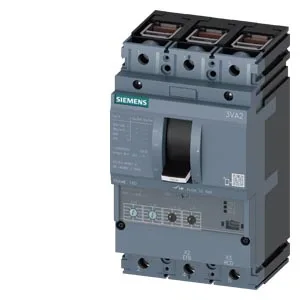
The Siemens 3VA2110-6HN36-0AB0 is a SENTRON molded case circuit breaker (MCCB) rated for 100 A continuous current with an interrupting capacity of 242 kA at 240 V — that's the headline number for this frame size, meaning it can safely clear a fault up to 242,000 amps without welding its contacts or rupturing the case. At 415 V it still holds 187 kA, and at 690 V it's rated 5 kA, so the interrupting curve drops fast once you push past 500 V. The overcurrent release is an ETU350 electronic trip unit — that's the middle-tier electronic trip in the 3VA line, giving you adjustable long-time, short-time, and instantaneous pickup settings plus ground-fault alarm capability (though this specific variant ships without ground-fault monitoring).
Panel fit and thermal derating
Footprint is 105 mm wide, 181 mm tall, 86 mm deep — standard 3-pole MCCB envelope for a 100 A frame. Thermal derating is published: it holds full 100 A up to 50 °C ambient, then drops to 96.25 A at 55 °C, 92.5 A at 60 °C, 88.75 A at 65 °C, and 85 A at 70 °C. That's a clean linear derate curve — useful if you're packing this into a hot panel near a drive or transformer.
What the interrupting ratings mean for your fault study
At 415/440 V it still delivers 187 kA, and at 500 V it's 121 kA — still very high for a 100 A frame. Only at 690 V does it drop to 5 kA, which is typical for this voltage class.