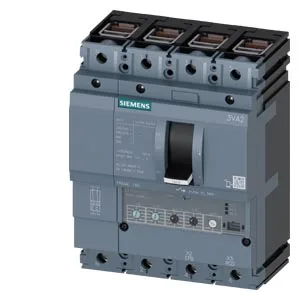
The 800 V rated insulation voltage keeps it safe on 690 V systems, where the interrupting rating drops to 3.7 kA — fine for downstream subfeeds but not for a main on a 690 V bus.
The 140 mm width on a 4-pole breaker is typical for the 100 A frame; verify the mounting footprint against your existing busbar spacing or DIN-rail adapter if retrofitting. Front protection is IP40, meaning no ingress protection against water but adequate for dry indoor switchgear.
That is the advantage of the electronic ETU350: it compensates for ambient temperature, so you do not have to oversize the frame for a hot environment. The interrupting ratings at different voltages (–) tell you where this breaker can serve as a main or a feeder. At 240 V and 415 V the numbers are high enough for any utility transformer secondary. At 500 V the 121 kA still covers most industrial bus ratings. At 690 V the 3.7 kA is low — use it only on low-fault subfeeds or downstream of a current-limiting device. The 4-pole design handles three-phase plus neutral — common for North American 120/208 V or 277/480 V wye systems where you need to switch the neutral.