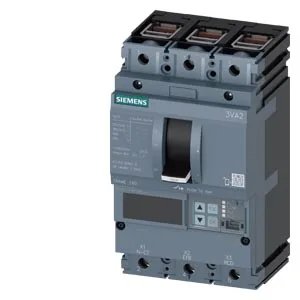
It carries an ETU850 electronic trip unit with communication capability, so it can report status and trip events over a network — useful for a plant-floor SCADA or a BMS that needs to know which breaker opened without sending someone to look. The interrupting ratings are what make this breaker fit for high-fault locations: 242 kA at 240 V, 187 kA at 415 V and 440 V, 121 kA at 500 V, and 3.7 kA at 690 V. That 242 kA at 240 V is the number that matters for most North American 277/480 V panels where the available fault current can push past 200 kA on the secondary of a large transformer. The 3.7 kA at 690 V tells you this is not a 690 V workhorse — it's a 240–500 V breaker. The adjustable current range runs from 150 A minimum to 1 200 A maximum, which is the setting window for the ETU850 trip unit. That means you can dial the long-time pickup anywhere in that band to match the load cable or transformer — you are not stuck at the 100 A frame rating. The continuous rating of 100 A is the frame's thermal limit; the trip unit settings govern the actual protection threshold.
Front protection is IP40, so it keeps out tools and fingers but not water. Power loss is 10 W maximum at rated current. That is low enough to skip forced cooling in a ventilated panel, but if you are packing ten of these in a sealed cabinet, add up the heat and plan for it.