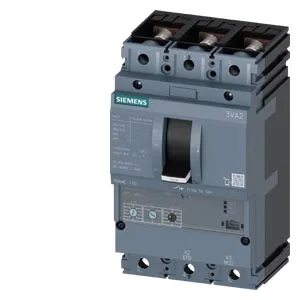
It carries the ETU350M electronic trip unit — that means adjustable thermal-magnetic or electronic overload and short-circuit protection curves, plus phase failure detection built in. The 330 kA breaking capacity at 240 V tells you it can interrupt very high fault currents without upstream fuses; at 415 V and 440 V it still holds 242 kA, and at 690 V it derates to 52.5 kA. For a motor branch circuit, the phase-failure detection is the feature that catches a lost phase before single-phasing burns out the winding.
Above that it steps down: 96 A at 55 °C, 94 A at 60 °C, 92 A at 65 °C, 90 A at 70 °C. If your panel internal ambient runs hot — say a sealed enclosure with drives — you need to factor that curve into the load schedule. That 105 mm width is three-pole standard for the 3VA2 frame; it fits the same DIN-rail or screw-mount pattern as other 3VA breakers, so a panel laid out for a 3VA1010 or 3VA1110 will accept this without re-drilling the gland plate. Maximum power loss is 75 W — that heat stays inside the enclosure, so account for it in the thermal budget.
Auxiliary contacts and wiring
That gives you two form-C signals for status feedback (breaker open/closed) and a dedicated alarm contact that changes state only on a trip event — useful for remote fault annunciation without wiring through the main contacts. No undervoltage release or shunt trip is fitted from the factory; the design of the auxiliary release is listed as 'without auxiliary release', so if you need UVR or a shunt, it must be added as a field-installable accessory.