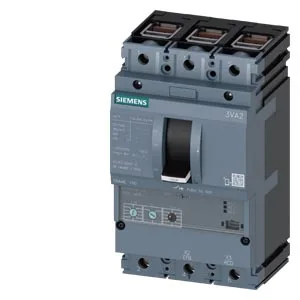
What this MCCB is and what it does
The Siemens 3VA2110-7MN36-0BC0 is a SENTRON molded case circuit breaker (MCCB) built specifically for motor protection. It's a 3-pole unit rated a full 100 A continuously from 40 °C all the way up to 70 °C ambient — no derating headache when it's mounted next to hot contactors in a crowded panel. The interrupting capacity hits 330 kA at 240 V, 242 kA at 415 V, and still 3.7 kA at 690 V, so it handles serious fault current without cascading upstream. Out here in the grease, that flat derating curve matters. A lot of breakers start shedding amps above 40 °C, but this one holds 100 A right through 70 °C. Means you can size it tight to the motor FLA without leaving a safety margin for panel heat — one less thing to recalc when the line gets hot.
Motor protection design and auxiliary hardware
This breaker is designed as a motor protection device, meaning its trip curve and thermal memory are tuned for starting inrush and running overload on induction motors. It includes phase failure detection — so if you lose a leg on a 3-phase motor, it trips before the winding cooks. The supplied basic switch is order code 3VA21107MN360AA0, and it ships with two HQ auxiliary switches plus an undervoltage release (UVR) built in. That UVR is a common safety requirement: if control voltage drops, the breaker opens, preventing an automatic restart. No communication function on this variant, and no ground-fault monitoring — it's a straightforward thermal-magnetic motor protector for standalone or simple interlocking schemes. Power loss at full load is 12.5 W, which is modest for a 100 A frame; you won't need to calculate extra ventilation for this one alone.
Physical fit and panel integration
Dimensions are 105 mm wide, 181 mm tall, and 86 mm deep. That 105 mm width is a standard 3-pole MCCB footprint — it occupies three 35 mm DIN spaces if you're mounting on a rail, or bolts directly to a backplate. The 86 mm depth means it clears most shallow enclosures; just watch for the arc-chamber clearance required by the manufacturer (typically 50 mm above and below for gas venting).
