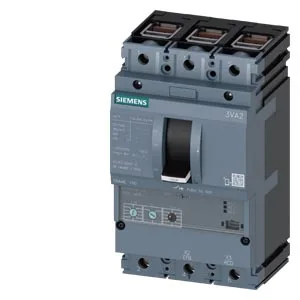
It's fitted with an ETU350M electronic overcurrent release — that's the microprocessor-based trip unit that gives you adjustable thermal and magnetic curves, plus phase-failure detection built in. The 330 kA breaking capacity at 240 V tells you this breaker can sit on a high-fault panel without upstream fusing; at 690 V it still interrupts 52.5 kA, which covers most industrial motor branch circuits.
This MCCB's interrupting rating drops as line voltage rises — that's normal for any breaker. At 240 V it's rated 330 kA; at 415 V and 440 V it holds 242 kA; at 500 V it's 187 kA; at 690 V it's 52.5 kA. For a 480 V panel (common in North America), you're looking at the 242 kA figure — that's well above what a typical 100 A feeder sees, so selectivity with downstream breakers is straightforward.
Temperature derating — what the 100 A means in a hot panel
At 55 °C it derates to 96 A; at 60 °C to 94 A; at 65 °C to 92 A; at 70 °C to 90 A. The maximum power loss is 75 W, which is heat that has to leave the enclosure.
Integrated accessories — shunt trip and auxiliary switches
The shunt trip is part of the base unit (order code 3VA2110-7MN36-0AA0 for the switch without accessories), and the auxiliary trip module is 3VA9688-0BL30.