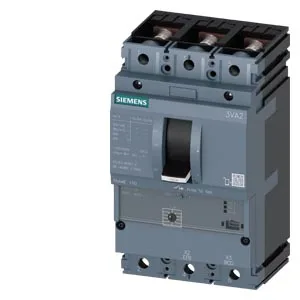
Siemens 3VA2110-7MS32-0CH0 — SENTRON MCCB, 100 A Frame, Adjustable Trip
That flat thermal profile is unusual; most MCCBs start backing off above 40 °C. Here it means the breaker holds its full 100 A rating even inside a crowded, poorly ventilated enclosure near a hot mill stand. The adjustable thermal-magnetic trip is set between 300 A and 1 500 A, so this is a high-frame breaker configured for a relatively low continuous load — the trip setting, not the frame rating, governs the actual protection point. The 3-pole construction handles three-phase motor and distribution circuits. A trip indicator gives visual confirmation of a fault event, useful for a field tech walking a line of breakers.
Breaking Capacity Across Voltage — Where It Clears
Breaking capacity drops sharply as system voltage rises: 330 kA at 240 V, 242 kA at 415 V and 440 V, 187 kA at 500 V, and 3.7 kA at 690 V. At 240 V through 500 V, the numbers are generous; coordination studies will have headroom.
Auxiliaries and Releases — Built-In, Not Add-On
The basic switch supplied is order code 3VA21107MS320AA0.