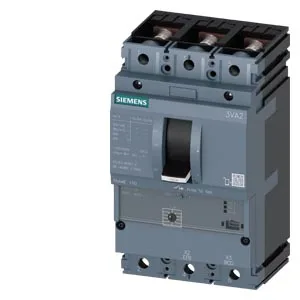
What this MCCB is and what it does
The Siemens 3VA2110-7MS32-0DA0 is a SENTRON molded case circuit breaker (MCCB) designed for starter protection — meaning it's built to sit ahead of a motor starter, combining short-circuit and overload protection in one 3-pole frame. Rated 100 A continuous across the full ambient range from 40 °C to 70 °C, it holds its full rating without derating up to that ceiling. The breaking capacity is the headline: 330 kA at 240 V, 242 kA at 415 V and 440 V, 187 kA at 500 V, and 3.7 kA at 690 V. That 330 kA at 240 V is a high-interrupting rating for a 100 A frame — it clears massive fault currents without cascading upstream, which matters when the available fault current at the panel is high.
Integration and mounting
The breaker occupies a 105 mm wide, 181 mm tall, 86 mm deep footprint — standard for a 3-pole SENTRON 3VA frame in this rating class. It mounts into a panel on a DIN rail or direct screw-mount pattern; the 86 mm depth leaves room behind the gland plate for cable bending radius. The supplied basic switch carries order code 3VA21107MS320AA0, so the internal switching mechanism is a known subassembly for replacement without pulling the whole breaker.
Undervoltage release and auxiliary release
This variant includes an undervoltage release (UVR) — the auxiliary release type is specifically an undervoltage release (UVR), which trips the breaker when supply voltage drops below a threshold. That's typical for motor protection circuits where a brownout or phase-loss condition should drop the load rather than let the motor single-phase. There is no trip indicator, no voltage trigger, no communication function, no phase failure detection, and no ground-fault monitoring on this version — it's a clean electromechanical MCCB with UVR only.
