What it is and what it does
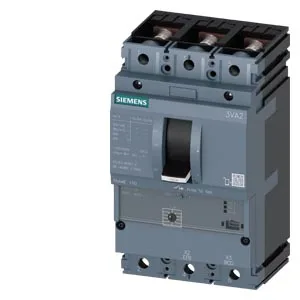
The Siemens 3VA2110-7MS32-0DH0 is a SENTRON molded case circuit breaker (MCCB) designed for starter protection — it sits upstream of a motor starter to provide short-circuit and overload backup, not primary motor overload protection. Rated 100 A continuously across the full ambient range from 40 °C to 70 °C, so no derating curve to chase in a warm panel. The adjustable thermal-magnetic trip covers 300 A minimum to 1500 A maximum, giving you selectivity headroom against downstream faults.
Breaking capacity — what the numbers mean for coordination
Breaking capacity is the hard number for fault coordination. At 240 V it interrupts 330 kA — that's a very high rating, typical for a large-frame MCCB used near a transformer secondary. At 415 V and 440 V it holds 242 kA, dropping to 187 kA at 500 V, and 3.7 kA at 690 V. The steep drop at 690 V tells you this breaker is optimized for 400–480 V distribution, not 690 V motor circuits. If your system fault current exceeds 242 kA at 415 V, you need a current-limiting upstream device or a different breaker.
Built-in auxiliaries and releases
This variant ships with an undervoltage release (UVR) and two auxiliary switches plus one trip alarm switch (HQ configuration). The UVR trips the breaker when control voltage drops below a threshold — standard for safety circuits that need to drop power on loss of control supply. The auxiliary switches provide status feedback to a PLC or panel lamp; the trip alarm switch signals a fault condition independently of the handle position. No communication module or ground-fault monitoring on this version — it's a straight electromechanical breaker.
Integration and footprint
Dimensions are 105 mm wide, 181 mm high, 86 mm deep — a standard 3-pole MCCB footprint for the 3VA2 frame. Mounts on a DIN rail or panel-mount plate. The 86 mm depth is shallow enough for most 600 mm deep enclosures; check clearance for the UVR wiring and auxiliary switch terminals on the side. Panel builders should account for the 12.5 W maximum power loss when sizing ventilation.