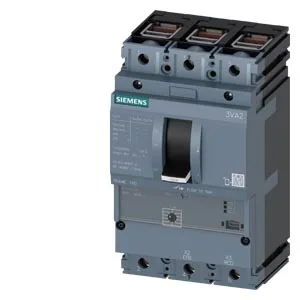
What this MCCB is and where it fits
The Siemens 3VA2110-7MS36-0AF0 is a SENTRON molded case circuit breaker (MCCB) designed for starter protection — meaning it's built to sit ahead of a motor contactor and handle the high inrush and locked-rotor currents a motor draws, not just resistive loads. Rated 100 A continuous at 40 °C through 70 °C (no derating across that band), it holds that rating flat across the full operating temperature range, which simplifies panel thermal budgeting. The 3-pole configuration with a 100 A frame covers most small-to-medium motor starters up to roughly 37 kW on 400 V systems, depending on the motor's full-load amps and starting method.
Breaking capacity — what the numbers mean for selectivity
The interrupting ratings here are the key to coordination. At 240 VAC it clears 330 kA — that's the maximum fault current it can safely interrupt at that voltage. At 415 V and 440 V it's rated 242 kA; at 500 V it drops to 187 kA; at 690 V it's 3.7 kA. The steep drop at 690 V tells you this breaker is optimized for 400 V class systems (the common European industrial voltage), not for 690 V distribution. For a panel fed by a transformer with a high short-circuit capacity — say 200 kA at 400 V — this breaker gives you headroom for selective coordination downstream, meaning a fault on a branch trips the branch breaker, not this main, keeping the rest of the line running.
Panel fit and integration
Dimensions are 105 mm wide, 181 mm high, 86 mm deep — a standard MCCB footprint for a 100 A frame. It mounts on a DIN rail or can be screw-fixed to a backplate. The 86 mm depth is the critical dimension for shallow enclosures; verify gland-plate clearance if the breaker sits near the back wall. Power loss is 10 W maximum, so in a sealed enclosure with multiple breakers, factor that into the thermal rise calculation. Operating temperature range is -25 °C to 70 °C; storage range is -40 °C to 80 °C, which covers most indoor and outdoor cabinet conditions in temperate climates.
