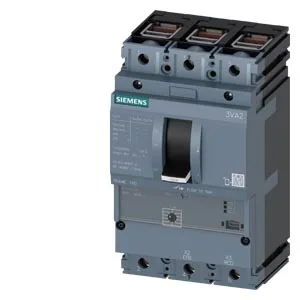
What this MCCB is and what the ratings mean for fit
The Siemens SENTRON 3VA2110-7MS36-0BC0 is a 3-pole molded case circuit breaker (MCCB) in the starter protection version, rated for a continuous current Iu of 100 A. That 100 A holds flat from 40 °C up to 50 °C, then derates to 96 A at 55 °C, 94 A at 60 °C, 92 A at 65 °C, and 90 A at 70 °C — so in a warm panel you still have nearly full ampacity, but above 50 °C you lose about 2 A per 5 °C step. Breaking capacity is the headline: 330 kA at 240 V, 242 kA at 415 V and 440 V, 187 kA at 500 V, and 52.5 kA at 690 V. Those are very high interrupting ratings — this breaker is sized for high-fault panels where the available short-circuit current is substantial, not for a light-duty distribution board. The 800 V rated insulation voltage (Ui) confirms it is built for 690 V line-to-line systems with margin. The overcurrent release is an ETU310M electronic trip unit, which gives adjustable thermal and magnetic protection curves — not a fixed thermal-magnetic. That matters for coordination studies: you can shape the trip characteristic to achieve selectivity with downstream breakers. The breaker also ships with an undervoltage release (UVR) and two HQ auxiliary switches built in, so it arrives ready for remote status and shunt-trip control without adding accessory modules.
Panel integration and physical fit
Dimensions: 105 mm wide, 181 mm high, 86 mm deep. That is a standard 3-pole MCCB footprint for the 3VA frame size — it mounts on a DIN rail or can be screw-fixed to a backplate. The 86 mm depth includes the arc chamber and terminals, so factor that into enclosure depth when the door is closed. Operating temperature range is -25 °C to +70 °C; storage range is -40 °C to +80 °C. Maximum power loss is 75 W at full load — that heat has to be managed in the enclosure, especially if the panel is densely packed. The 20 000 mechanical endurance cycles (latching) is typical for a fixed-mounted MCCB in this class; it is not a switching device for frequent motor starts.
