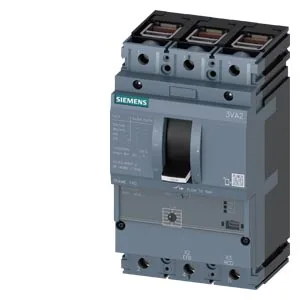
The Siemens 3VA2110-7MS36-0CL0 is a SENTRON molded case circuit breaker (MCCB) in a 3-pole configuration, rated for 100 A continuous current at 40 °C and carrying a 330 kA interrupting capacity at 240 V. It is designated as starter protection, meaning the overcurrent release (ETU310M) is tuned for motor-starting inrush profiles rather than pure distribution loads.
Interrupting capacity and thermal derating
The interrupting capacity drops across voltage levels: 330 kA at 240 V, 242 kA at 415 V and 440 V, 187 kA at 500 V, and 52.5 kA at 690 V. Thermal derating is flat from 40 °C to 50 °C at 100 A, then steps down: 96 A at 55 °C, 94 A at 60 °C, 92 A at 65 °C, and 90 A at 70 °C. For a panel running at 55 °C ambient (common in sealed enclosures with drives), the breaker is still good for 96 A continuous.
The latching endurance is rated at 20,000 operations — that is the mechanical life for the latch mechanism, not the electrical endurance under load. For motor-starting duty where the breaker cycles infrequently (a few times per shift), that endurance is effectively the panel's service life.