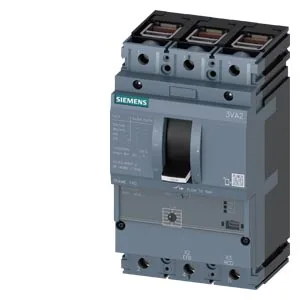
What it is — and what the ratings mean for fit
The Siemens 3VA2110-7MS36-0HL0 is a SENTRON molded case circuit breaker (MCCB) in the starter protection version — meaning it's built to sit ahead of a motor starter, combining branch-circuit protection with the high inrush tolerance a motor load demands. Three poles, 100 A rated continuous current Iu, and an 800 V rated insulation voltage Ui. The 330 kA interrupting rating at 240 V tells you this breaker can clear a massive fault upstream without welding its contacts; at 690 V it still holds 52.5 kA. That's the kind of SCCR headroom that lets you avoid a current-limiting fuse ahead of it in most 480 V panels. The overcurrent release is an ETU310M — a microprocessor-based trip unit with adjustable thermal and magnetic settings, so you dial in the motor's actual FLA rather than living with a fixed curve. Shunt trip (STL) is built in for remote emergency-off or supervisory tripping. Auxiliary contact complement is 2 aux switches plus 1 trip alarm plus 1 electrical alarm switch — that's enough to report status and trip back to a PLC without adding a separate module.
Thermal derating — what the 100 A really delivers in a warm cabinet
The 100 A Iu holds flat from 40 °C through 50 °C — no derating needed in a typical ventilated panel. At 55 °C it drops to 96 A, at 60 °C to 94 A, at 65 °C to 92 A, and at 70 °C to 90 A. If your panel ambient runs hot (say, next to a drive cabinet or in a non-climate-controlled enclosure), you lose about 1 A per 5 °C above 50 °C. The maximum operating temperature is 70 °C; storage range is -40 °C to 80 °C. Power loss maxes at 75 W — that's the heat you need to vent.
Panel fit — dimensions and mounting
The 3VA2110-7MS36-0HL0 measures 86 mm deep, 105 mm wide, 181 mm tall. It's a standard SENTRON 3VA frame size — mounts on a DIN rail or with screw-mount lugs. The 105 mm width means it occupies three 35 mm module spaces on the rail. Latching endurance is 20,000 operations — that's the mechanical life, not the electrical interrupt life, which will be lower at full rated current.
