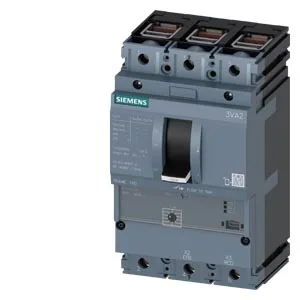
MCCB for high-fault panel builds
The Siemens SENTRON 3VA2110-7MS36-0JC0 is a 3-pole molded case circuit breaker (MCCB) rated for 100 A continuous at 40 °C through 70 °C — no derating needed across that span, which simplifies panel thermal budgeting. Its maximum current setting goes to 1 500 A, and the interrupting capacity hits 330 kA at 240 V, 242 kA at 415 V and 440 V, 187 kA at 500 V, and 3.7 kA at 690 V. That 330 kA figure at 240 V is the headline number for high-fault industrial panels where upstream transformer capacity is large.
What the ratings mean for fit
The 100 A rating is flat from 40 °C to 70 °C ambient — no thermal derating curve to calculate, which is unusual for an MCCB and saves panel design time. The adjustable trip range (300 A minimum to 1 500 A maximum) covers motor feeder and distribution applications where the load current is well below the breaker's ultimate frame rating. Breaking capacity at 690 V drops to 3.7 kA, so if your system runs at 690 V, verify that the available fault current stays under that limit. This MCCB includes a shunt trip (STL) release and two auxiliary switches (HQ) as standard, so it can be integrated into a safety circuit or remote-trip scheme without adding external accessories. It does not include undervoltage release, phase failure detection, ground-fault monitoring, or communication functions — those are separate variants in the 3VA2 family. Dimensions are 105 mm wide, 181 mm high, and 86 mm deep — a standard 3-pole MCCB footprint that fits most DIN-rail or panel-mount enclosures. The 10 W maximum power loss at rated current is modest; no forced cooling required in a typical IP54 enclosure.
Integration notes
Mounts on DIN rail or direct panel. The 3-pole design with line and load lugs accepts copper or aluminum conductors. The shunt trip (STL) requires a separate control voltage — verify polarity and voltage rating from the nameplate before wiring. The two auxiliary switches (HQ) are form-C contacts rated for 240 VAC; they can be used for status feedback to a PLC or to interlock with a contactor coil.
