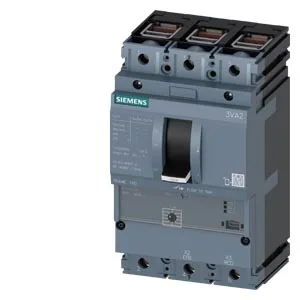
The adjustable overload range spans 300 A to 1500 A (–), which covers motor FLA from roughly 250 A up to 1200 A depending on the setting and application rules — a wide window that lets one frame size serve multiple motor ratings on the BOM. The interrupting capacity is the headline number that decides whether this breaker clears a fault without upstream damage: 330 kA at 240 V, 242 kA at 415 V and 440 V (–), 187 kA at 500 V, and 3.7 kA at 690 V. The steep drop to 3.7 kA at 690 V is a reminder that this is a 600 V class frame; at 690 V the breaker relies on the upstream protection for high faults. That means the breaker can signal its status to a PLC and be remotely tripped via a control voltage — standard for E-stop chains and automated restart schemes. The basic switch assembly is order code 3VA21107MS360AA0, which is the replaceable switching mechanism inside the frame.
That 105 mm width is a standard 3-pole MCCB footprint for this class — it fits a 4-inch (101.6 mm) DIN-rail or panel-mount cutout with minimal adjustment. The 86 mm depth (3.39 in) means it clears a 4-inch deep enclosure with room for rear bus connections. Maximum power loss is 10 W, so inside a sealed panel the heat contribution is modest — no forced ventilation required for a single unit.