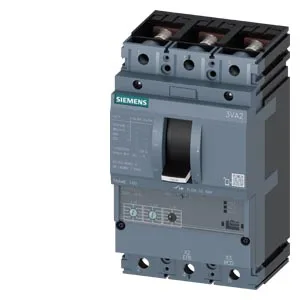
What this MCCB delivers — and what the ratings mean on your panel
The Siemens SENTRON 3VA2116-5HL32-0CA0 is a 3-pole molded case circuit breaker rated for 160 A continuous current (Iu) with an ETU320 electronic trip unit — that's the workhorse interrupting rating for distribution and motor feeder panels where you need adjustable thermal-magnetic or electronic protection curves. The 187 kA breaking capacity at 240 V AC means it can safely clear a fault up to that level without the arc flashing over or the breaker rupturing; at 415 V and 440 V it still holds 121 kA, and at 690 V it derates to 4.25 kA — so for 400 V class systems this breaker sits comfortably in high-fault-current positions like main incomers or bus-tie feeders. The rated insulation voltage Ui is 800 V, meaning the internal creepage and clearance distances are designed for 800 V systems — you can use this breaker on 690 V networks without derating the insulation. Maximum power loss at rated current is 28 W, which matters for enclosure thermal management when you pack several breakers in a row.
Thermal derating and ambient — the real-world current you can count on
The 160 A rating holds flat from 40 °C up to 50 °C — that's the standard panel ambient. At 55 °C it derates to 154 A, at 60 °C to 148 A, at 65 °C to 142 A, and at 70 °C to 136 A. If your panel runs hot (say, a non-ventilated enclosure near a furnace line or in a tropical outdoor cabinet), you need to factor that derating curve into your load schedule. The operating temperature range is -25 °C to +70 °C; storage range is -40 °C to +80 °C.
Panel fit and integration — dimensions and what connects where
The breaker measures 105 mm wide, 181 mm high, 86 mm deep — that's the standard 3VA2 frame footprint. It mounts on a DIN rail or can be screw-fixed to a backplate. The 3-pole design with no auxiliary contact version means you'll need to add an external auxiliary contact block if you want remote status feedback. The undervoltage release (UVR) is built in — it trips the breaker when control voltage drops below a threshold, which is standard for emergency-stop or safety-related disconnection circuits.
What the trip unit does — ETU320 electronic release
The ETU320 is an electronic overcurrent release with LSI protection curves (long-time, short-time, instantaneous). It gives you adjustable pickup and time-delay settings for selective coordination downstream — you can set the short-time delay so a feeder breaker clears a fault before this main breaker trips, keeping the rest of the bus live. No communication function, no phase-failure detection, no ground-fault monitoring on this variant — it's a pure line-protection breaker for standard distribution.
