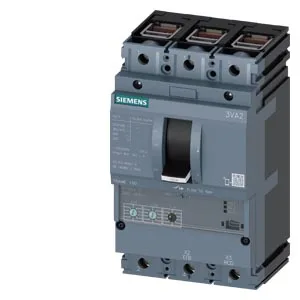
The Siemens SENTRON 3VA2116-5HL36-0DH0 is a 3-pole molded case circuit breaker rated for 160 A continuous at 40 °C through 70 °C — no derating needed across that band, which simplifies panel schedules in warm environments. Its interrupting capacity hits 187 kA at 240 V, dropping to 121 kA at 415 V and 440 V, then 75.6 kA at 500 V, and 3.7 kA at 690 V. This is a line-protection design, meaning it's built for overcurrent and short-circuit protection on distribution feeders, not motor-starting duty.
Integration and mounting — panel fit without surprises
Depth of 86 mm (3.39 in) fits standard enclosure depths; verify gland-plate clearance if back-panel wiring runs behind the breaker.
Auxiliary and release wiring — what terminates where
The auxiliary switch block provides two form-C auxiliary contacts plus one dedicated trip-alarm switch (HQ type). The undervoltage release (UVR) is factory-installed — verify coil voltage rating against your control circuit before energizing. There is no communication function or ground-fault monitoring on this variant, so external modules are needed for those features.