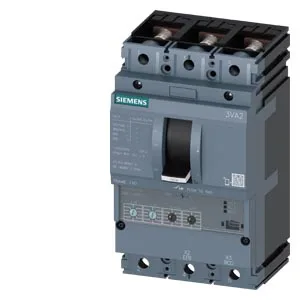
160 A MCCB with ETU350 — breaking capacity that scales with your fault level
What sets this frame apart is the breaking capacity curve: 187 kA at 240 V, 121 kA at 415 V and 440 V, 79 kA at 500 V, and 4.25 kA at 690 V. That means at common low-voltage distribution levels (240–480 V) you have headroom for high-fault installations without cascading upstream — the breaker clears the fault within its own rating. At 690 V the interrupting capacity drops sharply, so for 690 V applications verify that 4.25 kA covers your available fault current. The ETU350 is a basic electronic trip unit with fixed time-current curves — no communication, no voltage trigger, no ground-fault monitoring. It is sized for straightforward feeder or main breaker duty where you need selective coordination via the LI (long-time and instantaneous) settings.
At 55 °C it derates to 154 A, at 60 °C to 148 A, at 65 °C to 142 A, and at 70 °C to 136 A. For a panel that runs hot — say a non-ventilated enclosure near a furnace line — you can still apply this breaker but need to factor the derated current into your load schedule. Maximum power loss is 25.5 W, which matters for enclosure thermal budgeting.