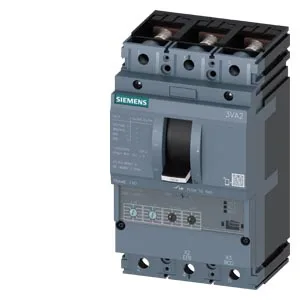
Its 3-pole design handles line protection in distribution panels, switchboards, and motor control centers where a fixed thermal-magnetic or electronic trip unit is specified. The interrupting capacity reaches 187 kA at 240 V AC, 121 kA at 415/440 V, 75.6 kA at 500 V, and 3.7 kA at 690 V, covering high-fault service-entrance and sub-distribution applications.
That simplifies panel airflow planning: the breaker delivers its full nameplate even in a warm enclosure. The 187 kA at 240 V is the highest short-circuit rating on this frame; at 690 V the 3.7 kA figure reflects the arc-extinction limits of a 3-pole MCCB at line-to-line voltage.
This variant ships with two auxiliary switches (HQ design) and an undervoltage release (UVR) factory-installed. Maximum power loss is 28 W at rated current, which matters for enclosure heat-load calculations.
The 105 mm width matches the common 4-module (4 x 27 mm) spacing on DIN-rail, though this breaker typically bolts to a mounting plate in a switchboard rather than snapping onto a rail. Verify the bus-bar or cable-connection clearance against the 86 mm depth plus any rear-connection adapters.