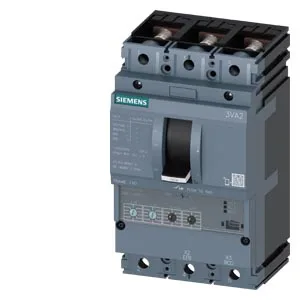
It carries an undervoltage release (UVR) as standard, so a drop in supply voltage below the release threshold trips the breaker — useful for preventing motor re-acceleration after a sag or outage without a separate control relay.
The interrupting rating is not a single number — it depends on the system voltage. At 240 V this MCCB clears 187 kA; at 415 V and 440 V it holds 121 kA; at 500 V it drops to 75.6 kA; and at 690 V it is rated 3.7 kA. For a 400 V panel with a transformer-fed fault current of, say, 85 kA, the 121 kA rating at 415 V gives headroom. At 690 V the 3.7 kA limit means this breaker is not the right choice for a high-fault 690 V bus — that is a coordination call the site electrical engineer needs to make.
That simplifies panel design: the breaker delivers its full nameplate current inside a switchboard running at 60 °C without a de-rate factor.
The 86 mm depth (3.39 in) fits typical shallow enclosures; verify the gland plate clearance if the breaker sits near a back-panel door.