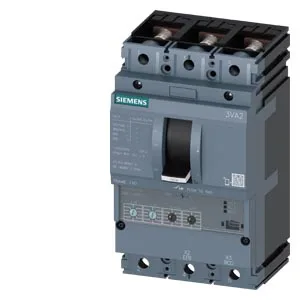
That 160 A holds up to 50 °C ambient; above that, the thermal derating curve drops it to 154 A at 55 °C, 148 A at 60 °C, 142 A at 65 °C, and 136 A at 70 °C — so if your panel runs hot, the effective ampacity is lower than the nameplate. Breaking capacity is the headline here: 187 kA at 240 V AC, 121 kA at 415 V and 440 V, 79 kA at 500 V, and 4.25 kA at 690 V. At 690 V the capacity drops sharply to 4.25 kA, so verify your available fault current if you're using it on a 690 V system. Maximum power dissipation is 28 W — relevant for thermal management inside a sealed enclosure.
Undervoltage release and auxiliary contacts
The base switch (the breaker mechanism itself) is order code 3VA2116-5HN32-0AA0 — the -0DC0 suffix adds the UVR and auxiliary switches as a factory-assembled variant. No communication function, no phase failure detection, no ground fault monitoring on this version — it's a straight line-protection MCCB with undervoltage release.
Lifecycle and sourcing — current production, no obsolescence concern
The mechanical endurance (latching cycles) is rated at 20,000 operations. These are standard figures for a 160 A frame MCCB in industrial service.
Physical fit — dimensions and panel integration
That 105 mm width is the standard 3-pole frame width for the 3VA2 frame size — it occupies roughly 4.1 inches of DIN rail or panel-mounting surface. The 86 mm depth includes the arc chute and terminals; ensure at least 100 mm clearance in front for wiring and arc flash boundary.