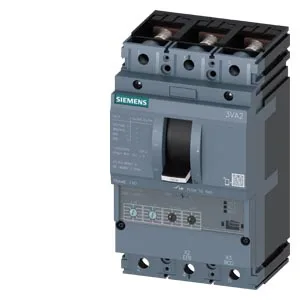
The Siemens 3VA2116-5HN32-0HL0 is a SENTRON 3VA2 molded case circuit breaker (MCCB) rated for 160 A continuous current across the full ambient range from 40 °C to 70 °C — no derating needed up to that ceiling. Three poles, line protection design, meaning it is intended for feeder and distribution circuits rather than motor protection (no adjustable thermal-magnetic curve for motor starting). Breaking capacity is the headline: 187 kA at 240 V AC, 121 kA at 415 V and 440 V, 75.6 kA at 500 V, and 3.7 kA at 690 V. The steep drop at 690 V (3.7 kA) is typical for a 160 A frame; if your application is 690 V with higher available fault current, you need a larger-frame breaker. That means remote status and remote tripping are built in — no add-on modules needed for basic signaling and emergency shutdown.
The closest functional peer in the same 3VA2 family is 3VA2116-5HL32-0AK0. Both are 160 A, 3-pole, line-protection MCCBs on the same frame. The difference is in the accessory package: the -5HL32-0AK0 carries a different auxiliary switch configuration (likely fewer switches or no shunt trip). If your panel was wired around the -5HL32-0AK0, the -5HN32-0HL0 will physically drop into the same mounting footprint and bus-bar connection — same 105 mm width, same depth, same terminal layout — but the auxiliary wiring differs because the switch complement is richer on this unit. You would need to re-terminate the control wires, not re-mount the breaker.