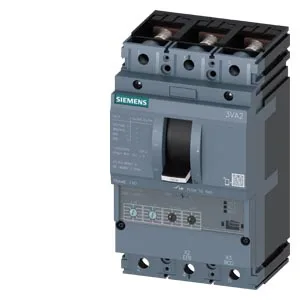
Its 160 A rated continuous current Iu at 40 °C holds steady through 50 °C before it starts to derate — at 55 °C it carries 154 A, at 60 °C it carries 148 A, at 65 °C it carries 142 A, and at 70 °C it carries 136 A. That thermal curve tells you the breaker is comfortable in a warm enclosure; you don't lose headroom until the ambient passes 50 °C. At 690 V it still interrupts 4.25 kA, which covers most motor-circuit faults at that voltage. The ETU350 electronic trip unit gives adjustable long-time, short-time, and instantaneous protection; it's a line-protection version, so it's set up for feeder duty rather than generator or motor protection. No communication function, no phase failure detection, no ground fault monitoring — this is a straightforward thermal-magnetic replacement with electronic trip precision. The auxiliary trip module is order code 3VA9688-0BL32; the basic switch is 3VA2116-5HN32-0AA0. No undervoltage release is fitted, so if you need UVR protection for a motor starter interlock, you'll add that separately.
That width is the standard 105 mm frame for 160 A SENTRON breakers — it occupies three 35 mm DIN spaces (105 mm ÷ 35 mm = 3 modules). Maximum power loss is 25.5 W, so ventilation in a sealed panel is advisable if you're grouping several breakers.
Comparison with a close sibling
The closest functional peer is 3VA2116-5HL32-0AK0. Both are 160 A, 3-pole SENTRON MCCBs with ETU350 trip units. The difference is in the auxiliary configuration: this -5HN32-0JC0 carries two HQ auxiliary switches and a shunt trip (STL); the -5HL32-0AK0 carries a different auxiliary contact set and an undervoltage release instead of a shunt trip. If your panel was wired for an undervoltage release (UVR), the -5HL32-0AK0 is the drop-in; this -5HN32-0JC0 is the right pick when you need remote trip via shunt trip and status indication from two auxiliary contacts. Panel cutout and bus connection are identical — same 105 mm frame, same mounting pattern.