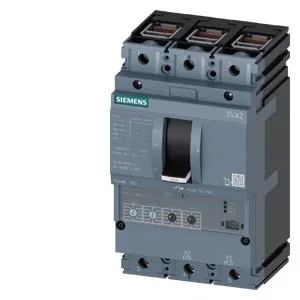
The interrupting ratings are what define its fit in a distribution board: 187 kA at 240 V AC, 121 kA at both 415 V and 440 V, 79 kA at 500 V, and 4.25 kA at 690 V. The thermal derating curve is published across the operating range: the breaker carries the full 160 A from 40 °C through 50 °C, then steps down to 154 A at 55 °C, 148 A at 60 °C, 142 A at 65 °C, and 136 A at 70 °C.
Auxiliary contacts and undervoltage release — what's wired in
That's the full complement for remote status indication — open/closed, trip, and alarm on separate signal paths. The undervoltage release (UVR) is factory-fitted; its design is the standard undervoltage release type. The auxiliary trip assembly carries order code 3VA9608-0BB11, and the supplied basic switch assembly is 3VA2116-5HN36-0AA0 — these are the internal sub-assemblies, not external accessories. The breaker itself draws a maximum power loss of 28 W at rated current; that's the heat you need to account for in the enclosure thermal calculation.
Physical fit and environmental limits
Dimensions: 105 mm width, 181 mm height, 86 mm depth. That depth of 86 mm is the dimension from the mounting surface to the front of the breaker — relevant when fitting into a shallow enclosure or when clearance is needed for the arc chamber behind a deadfront. The latching endurance is rated at 20,000 operations — that's the mechanical life for the switching mechanism under no-load conditions.