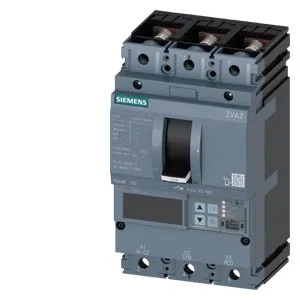
What this MCCB is and what it protects
The Siemens 3VA2116-5JQ32-0AB0 is a SENTRON molded case circuit breaker (MCCB) designed for line protection — the primary role of guarding a feeder or distribution circuit against overload and short-circuit faults. It is a 3-pole unit with a full-scale rating of 160 A and an initial trip threshold of 32 A, meaning the thermal-magnetic trip curve starts its overload detection at that lower pickup point before ramping to the full 160 A continuous current rating. Rated interrupting capacity reaches 187 kA at 240 V, 121 kA at 415 V and 440 V, 75.6 kA at 500 V, and 3.7 kA at 690 V. Those are the fault currents this breaker can safely clear at each voltage level — critical for selectivity studies and ensuring the upstream transformer or bus can deliver a fault without the breaker failing to interrupt. The breaker carries 160 A continuously from 40 °C up to 70 °C ambient.
Panel fit and integration
Footprint is 105 mm wide by 181 mm tall by 86 mm deep — a standard 3-pole MCCB envelope that drops into most SENTRON distribution panels and switchboard cubicles without re-drilling the mounting plate. The 86 mm depth leaves clearance behind the breaker for wiring and busbar connections. This variant includes a communication function and comes factory-fitted with 2 auxiliary switches HP for status feedback. Ground-fault monitoring is configured for summation current formation on the L-conductor, which means it measures the vector sum of phase currents to detect leakage to earth. That is the typical setup for solidly-grounded systems where you want ground-fault protection without a separate GFCI module.
Lifecycle and sourcing posture
Maximum power loss is 25.5 W at rated load, which is typical for a 160 A frame MCCB and should be factored into the enclosure thermal budget. Operating temperature range is -25 °C to 70 °C; storage range is -40 °C to 80 °C.
