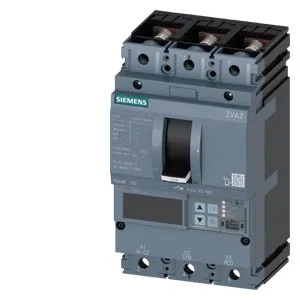
The Siemens 3VA2116-5JQ32-0AE0 is a 3-pole SENTRON molded case circuit breaker (MCCB) rated for 160 A continuous current, holding that rating flat across the full ambient range from 40 °C to 70 °C — no derating needed up to the enclosure's internal temperature limit. It's designed for line protection, meaning the trip curve and interrupting capacity are tuned for feeder and main breaker duty rather than motor branch circuits. Interrupting capacity varies sharply with system voltage: 187 kA at 240 V, 121 kA at 415 V and 440 V, 75.6 kA at 500 V, and 3.7 kA at 690 V. That 3.7 kA figure at 690 V is the binding constraint for high-voltage industrial feeders — verify your available fault current at the point of common coupling doesn't exceed that ceiling.
Panel fit and integration
Footprint is 105 mm wide by 181 mm tall by 86 mm deep — a standard 3-pole MCCB envelope that drops onto a DIN rail or panel-mount base. The 86 mm depth (3.39 in) matters when gland-plate clearance is tight; leave at least 100 mm in front of the DIN rail for the arc-chamber exhaust and wiring sweep. Max power loss is 25.5 W at rated load. In a sealed enclosure with multiple breakers ganged, that heat load adds up — factor it into the thermal budget rather than relying on free-air convection alone.
Key ratings and what they mean
The 160 A full-scale rating is the continuous current the breaker carries without tripping. It holds that rating from 40 °C up to 70 °C ambient — no thermal derating curve to calculate for typical panel temperatures. The minimum adjustable trip setting is 240 A (the long-time pickup floor), and the maximum is 1 600 A (the short-time or instantaneous ceiling), giving a wide coordination window for selective tripping with downstream devices. Communication function is onboard, so this breaker can report status and trip events over the SENTRON bus without an external module. The auxiliary switch configuration is 4 HQ switches — high-quantity auxiliary contacts for remote indication, interlocking, or PLC feedback. Ground-fault monitoring uses summation current formation on the L-conductor — it measures the vector sum of phase currents to detect leakage to earth. That's a standard residual-current method, not a zero-sequence CT; the breaker itself handles the detection, no external RCM needed. Operating temperature range is -25 °C to +70 °C; storage range is -40 °C to +80 °C. The storage minimum matters if the breaker sits in an unheated warehouse before installation — it's rated to survive the cold without damage.
