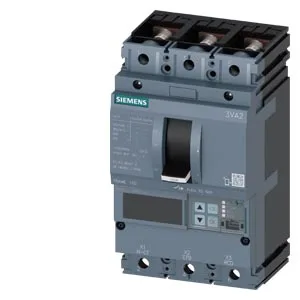
The Siemens 3VA2116-5JQ32-0CC0 is a SENTRON molded case circuit breaker rated for 160 A continuous current at 40 °C, with the current staying flat at 160 A through 50 °C before it starts to derate—154 A at 55 °C, 148 A at 60 °C, 142 A at 65 °C, and 136 A at 70 °C. Breaking capacity is 187 kA at 240 V, 121 kA at 415 V and 440 V, 79 kA at 500 V, and 4.25 kA at 690 V—so the interrupting rating drops sharply above 500 V. On a 480 V or 600 V class panel, the 79 kA at 500 V figure is the one that governs SCCR coordination; the 690 V figure of 4.25 kA is low, so if your system runs at 690 V, this breaker is only suitable for low-fault locations. No trip indicator, no voltage trigger, no phase-failure detection. Communication is supported (the listing shows a communication function present), so it can talk to a higher-level system for status or remote trip. Endurance is rated at 20 000 operations, which is solid for a breaker this size.
The UVR (undervoltage release) is a factory-fitted option that trips the breaker when supply voltage drops below a threshold—common for safety circuits or to prevent motor re-acceleration after a dip. The ETU560 electronic trip unit allows field-adjustable settings, so you can coordinate with downstream breakers without swapping trip units. Ground-fault monitoring is configured for summation current formation on the L-conductor, meaning it can detect ground faults by summing the phase currents—useful for solidly-grounded systems where residual current monitoring is needed.