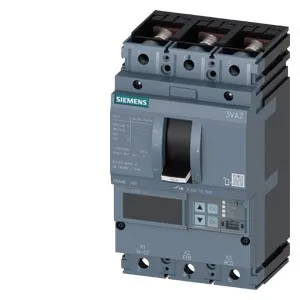
The Siemens SENTRON 3VA2116-5KQ32-0AA0 is a 3-pole molded case circuit breaker (MCCB) designed for line protection, rated at 160 A continuous current and 800 V insulation voltage. It breaks up to 187 kA at 240 V, 121 kA at 415 V, and still holds 75.6 kA at 500 V — numbers that tell you this breaker is built for high-fault industrial distribution, not light commercial. The 160 A rating holds flat from 40 °C all the way to 70 °C, so no derating headache when the panel sits next to a crusher drive cabinet.
The 187 kA at 240 V is the headline — that is the interrupting capacity at the lowest common industrial voltage, meaning this breaker can clear a bolted fault on a 240 V bus without needing a current-limiting fuse upstream. At 415 V it still delivers 121 kA, which covers most European and Asian distribution panels. The 3.7 kA at 690 V is a steep drop, but that voltage band is rare in MCCB duty; if your system runs 690 V, verify the fault current stays under that limit. The 160 A continuous rating is derate-free across the full 40–70 °C operating range, so the breaker's thermal-magnetic trip does not drift in a hot enclosure.
This MCCB is a panel-mount unit — 105 mm wide, 181 mm tall, 86 mm deep. The 3-pole footprint fits standard SENTRON mounting plates and busbar systems. The communication function (Ethernet or PROFIBUS via optional module) lets the breaker talk to a PLC or SCADA for remote trip indication and load monitoring, which is useful when the panel is in a dusty mill room you do not want to walk into every shift.