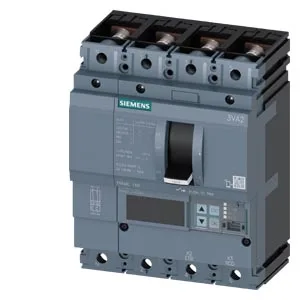
It carries a 187 kA interrupting capacity at 240 V, derating to 121 kA at 415 V and 440 V, 75.6 kA at 500 V, and 3.7 kA at 690 V — so at typical 400 V industrial feeds, it clears faults up to 121 kA without cascading upstream. That SCCR headroom matters for coordination studies: you can leave downstream breakers with lower ratings as long as the let-through energy is coordinated.
The 4-pole body takes up the same width as a 3-pole unit with a neutral pole integrated, so if you're swapping in from a 3-pole spec, check the gland plate clearance on the neutral side. Power loss hits 25.5 W maximum at rated load — that's warm enough to consider lateral spacing in a densely populated panel, but within the range of a standard SENTRON MCCB. No derating needed across the full ambient range from -25 °C to 70 °C; the 160 A rating holds flat from 40 °C through 70 °C, which is useful for hot-side installations like near furnace controls or outdoor enclosures in direct sun.
Protection and monitoring functions
This breaker includes ground-fault monitoring via summation current formation on L + N conductors. It also carries a communication function and an other measurement function. No undervoltage release or voltage trigger on this variant. The trip unit is set with a full-scale value of 160 A and an initial pickup of 32 A — that suggests an electronic trip with adjustable long-time and short-time thresholds. No mechanical trip indicator on this unit, so fault events need to be read via the communication interface or local display if fitted.