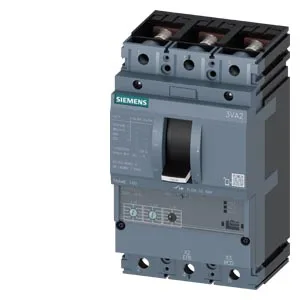
MCCB for high-fault service entrance and feeder duty
The Siemens SENTRON 3VA2116-6HL32-0BH0 is a 3-pole molded case circuit breaker rated for 160 A continuous current with no derating across the full 40 °C to 70 °C ambient range — meaning you can load it to nameplate in a warm enclosure without recalculating the wire size. Its interrupting capacity of 242 kA at 240 V AC puts it squarely in service-entrance and main-feeder duty where fault current from the utility transformer can exceed 100 kA; at 415 V and 440 V it still holds 187 kA, so it handles the high-fault end of a 400 V distribution board. The 86 mm depth and 105 mm width fit the standard SENTRON 3VA mounting footprint, and the built-in undervoltage release (UVR) plus the 2 auxiliary switches + 1 trip alarm switch HQ give the control engineer a clean way to signal the PLC that the breaker has tripped or the control voltage has dropped.
Rated current holds flat across the enclosure temperature range
The maximum power loss of 28 W at rated load is moderate for this frame size and means the internal heat won't drive up the enclosure temperature significantly beyond what the surrounding gear produces.
Breaking capacity by voltage — selectivity planning
The 242 kA at 240 V AC is the headline number, but the real-world values for 400 V-class distribution are the 187 kA at 415 V and 440 V. At 500 V it drops to 121 kA, and at 690 V it falls to 3.7 kA — that last figure is low enough that you would not use this breaker as the main on a 690 V drive panel unless the available fault current is confirmed below 3.7 kA. For a 400 V main switchboard with a transformer rating above 2 MVA, the 187 kA gives comfortable headroom for full selectivity with downstream 50 kA MCCBs.
Built-in auxiliary switches and undervoltage release
The undervoltage release (UVR) is also factory-installed; it drops the breaker when the control voltage falls below the dropout threshold, which is standard for emergency-stop circuits and undervoltage protection schemes. The trip indicator on the front gives a visual confirmation that the breaker has opened on fault, not manually.
Mounting dimensions are 105 mm wide by 181 mm tall by 86 mm deep — the standard 3VA 160 A frame. It operates from -25 °C to 70 °C and stores from -40 °C to 80 °C, so it is fine for unheated enclosures in temperate climates as long as the interior stays above -25 °C. The 3-pole design means it needs three line-side and three load-side conductors; the line-protection designation indicates it is set up for feeder protection rather than motor protection (no adjustable thermal curve for motor overload).