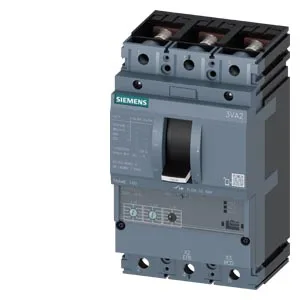
It carries a 242 kA interrupting capacity at 240 V, dropping to 187 kA at 415 V and 440 V, 121 kA at 500 V, and 3.7 kA at 690 V — so the breaking capacity you actually get depends on your system voltage, and at 690 V it's derated sharply. This is a line-protection design (not a motor-protector version), meaning it's sized for feeder and main breaker duty where the load is a cable or busbar, not a motor starting profile.
The two auxiliary switches give you status feedback (open/closed) for PLC inputs or remote indication without adding a separate accessory block. No communication module, voltage-trip module, or ground-fault monitoring is built in — this is a plain-vanilla thermal-magnetic MCCB with UVR and aux contacts. If you need Modbus or ground-fault, you're looking at a different variant in the 3VA2 family.
The 105 mm width is typical for a 160 A frame; verify your busbar spacing and enclosure depth (86 mm) before committing the gland plate. For a multi-breaker lineup, sum the losses and check the thermal rise against your enclosure rating.