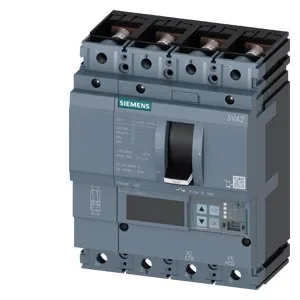
At 240 V it interrupts 242 kA — that is the full available fault current a utility transformer can deliver at the service entrance, so this breaker goes upstream in a main or tie position where you need the highest interrupting rating. At 415 V the rating drops to 187 kA; at 500 V it holds 121 kA; at 690 V it still clears 3.7 kA, which covers most motor-circuit faults on that voltage class. That means no derating curve to calculate for a warm panel — the breaker delivers its nameplate 160 A even at 70 °C ambient.
The 140 mm width (5.51 in) is a standard 4-pole MCCB pitch — it occupies four 35 mm DIN-rail module spaces. Depth of 86 mm (3.39 in) leaves clearance behind a 200 mm deep enclosure door.
Ground-fault monitoring and communication
This variant includes ground-fault monitoring via summation current formation on L+N conductors — it detects residual current by summing phase and neutral, so it works on 4-wire systems without a separate core-balance CT. Communication function is built in, enabling integration with higher-level monitoring or BMS systems.