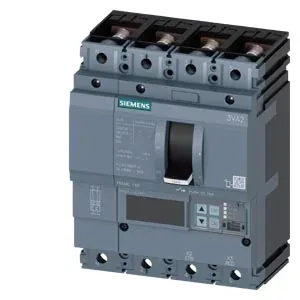
MCCB for 160 A feeder protection with high fault-current headroom
Its 242 kA interrupting capacity at 240 V means it can clear a bolted fault at the service entrance without upstream fuses or a current-limiting reactor; the 187 kA at 415 V and 440 V covers most industrial distribution panels. The 4-pole construction handles three-phase plus neutral, and the line-protection design (thermal-magnetic trip curve) suits feeder or main breaker duty in switchboards and panelboards. Communication function is built in, so it can report status and trip events to a BMS or PLC without an add-on module. Ground-fault monitoring uses summation current sensing on L+N, so it detects leakage without a separate GFCI module.
Interrupting performance by voltage level
The 242 kA at 240 V is the headline number, but the real-world selectivity picture changes as voltage climbs: 187 kA at 415 V and 440 V, then 121 kA at 500 V, and a sharp drop to 3.7 kA at 690 V. That 690 V figure is the limiting case — if your system runs 690 V line-to-line with available fault current above 3.7 kA, this breaker will not clear it.
Environmental and electrical ratings
Insulation voltage rated at 800 V. No undervoltage release or voltage-trip accessory is included; the trip indicator is absent, so fault cause must be read from the communication interface or a downstream meter.