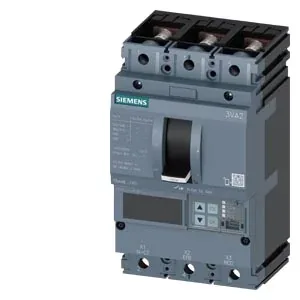
The Siemens SENTRON 3VA2116-7JP32-0AA0 is a 3-pole molded case circuit breaker rated for a continuous current of 160 A across the full ambient range from 40 °C to 70 °C — no derating needed up to that ceiling. That flat thermal curve is unusual; most MCCBs start to derate above 40 °C. Breaking capacity is what decides whether this breaker survives a fault. At 240 V it clears 330 kA — that is a very high interrupting rating, typical for a line-side main in a high-fault industrial panel. At 415 V and 440 V it still holds 242 kA, and at 500 V it clears 187 kA. The drop to 3.7 kA at 690 V is the limit of the 3VA platform at that voltage; if your system runs 690 V and fault current exceeds that, you need a different frame. For most 400 V-class distribution, the 242 kA figure gives ample headroom for selective coordination.
If you are sourcing against a panel built around the 5SQ2370-2YA05 or 5SQ2370-2YA01, those are physically different frames — the 3VA series has a different mounting footprint and terminal layout, so a direct drop-in without rewiring is not guaranteed.
Dimensions are 105 mm wide, 181 mm tall, and 86 mm deep — a standard 3-pole MCCB footprint that fits most 600 mm wide distribution panels. The communication function (listed as yes) means the ETU550 can interface with a PROFIBUS or PROFINET gateway for remote trip indication and current monitoring, though the specific communication module is ordered separately. No undervoltage release or shunt trip is built in — those are accessory modules that plug into the left side of the breaker. If your safety circuit requires a UVR for emergency stop, you will need to add the appropriate Siemens accessory. The absence of a trip indicator (no) means you cannot tell visually whether the breaker tripped on fault versus being manually opened; a remote indication via the communication module is the workaround.