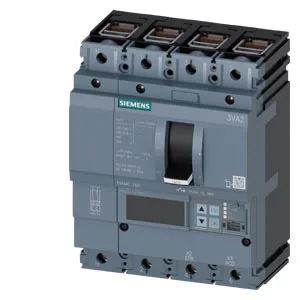
What this MCCB delivers in a distribution panel
Breaking capacity is the headline selector here: 330 kA at 240 V, 242 kA at 415 V and 440 V, 187 kA at 500 V, and 3.7 kA at 690 V. That simplifies panel thermal calculations: the breaker delivers its full 160 A at 70 °C ambient, which is unusual for a compact MCCB frame.
Dimensions: 181 mm height, 140 mm width, 86 mm depth. The 140 mm width across four poles is the critical fit dimension — verify the panel cutout or mounting plate accommodates that pole pitch before committing the layout. Maximum power loss is 25.5 W. In a sealed or low-ventilation enclosure, that loss figure drives the internal temperature rise; factor it into the thermal budget alongside the other breakers in the same compartment. Communication function is built in — the breaker supports integration into a higher-level monitoring or control system, which is relevant if the panel requires remote trip indication or energy metering over a bus. Ground-fault monitoring is implemented as summation current formation on the L + N conductor. That means it measures vector sum of phase and neutral currents to detect leakage to earth — a common requirement in IT or TN-S systems where ground-fault protection is mandated.