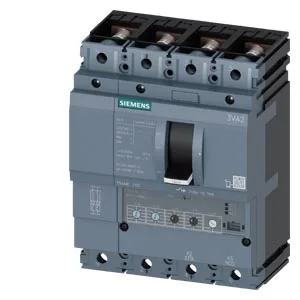
The 25 A is the full-scale value; the adjustable thermal-magnetic trip starts at a minimum setting of 15 A. The interrupting capacity is where this breaker earns its panel space: 187 kA at 240 V AC, 121 kA at 415 V and 440 V, 75.6 kA at 500 V, and 3.7 kA at 690 V. Those numbers mean it can clear a fault at the full available short-circuit current of most industrial distribution boards without the upstream breaker needing to trip — selectivity stays intact. It's designed for high-fault locations like a transformer secondary or a main switchboard feeder. The ground-fault monitoring uses summation current formation on L+N conductors — that's a residual-current detection method built into the breaker body, not an external module.
That 140 mm width across four poles is standard for a SENTRON 3VA2 frame — it fits the same DIN-rail or mounting-plate footprint as other 3VA2 4-pole breakers. No undervoltage release fitted (no voltage trigger), so if the panel spec calls for UVR the buyer needs a different variant or an add-on accessory. No trip indicator either — visual status is via the handle position only.
The 3VA2 platform is Siemens' mainstream MCCB line, widely specified in commercial and industrial panels.