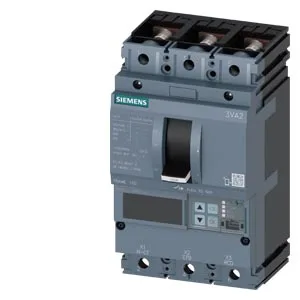
Its headline breaking capacity hits 187 kA at 240 V, dropping to 121 kA at 415 V and 440 V, 75.6 kA at 500 V, and 3.7 kA at 690 V — so it handles high-fault utility feeds at lower voltages but derates sharply above 500 V. It also carries a communication function, so it can report status or trip events to a higher-level system. The front face is IP40 rated, suitable for enclosed panel mounting.
The 86 mm depth (3.39 in) leaves clearance for rear-connected busbars or cable ducts behind the mounting plate. The optional motor drive allows remote racking-in or -out without opening the door, useful for automated testing or emergency disconnect sequences.
What the ETU560 release means for coordination
That matters when you are coordinating downstream branch breakers: the short-time delay band lets you achieve selectivity up to the breaker's withstand rating, so a fault on a feeder does not take out the main. The ground-fault function monitors residual current via summation of the three phase conductors — set the pickup level per the installation's earth-leakage requirements. Maximum power loss is 0.6 W, negligible for panel heat-budget calculations.