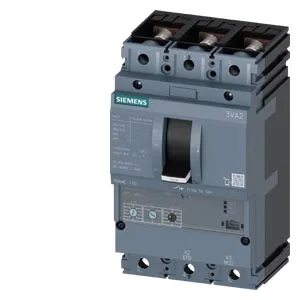
It includes phase failure detection and adjustable trip classes 10A, 10E, and 20E, letting you match the thermal curve to the motor's starting profile. The interrupting capacity hits 187 kA at 240 V, 121 kA at 415 V, and still holds 75.6 kA at 500 V — enough for high-fault industrial panels without cascading upstream.
The 3-pole design with no undervoltage release or communication module keeps wiring simple: line in, load out, and a separate control circuit for the trip coil if needed.
The adjustable trip class (10A, 10E, 20E) lets you set the overload delay: 10A for standard motor start, 10E for longer acceleration (e.g., high-inertia loads), 20E for extended start times. Phase failure detection trips the breaker if one phase drops out, protecting the motor from single-phasing.