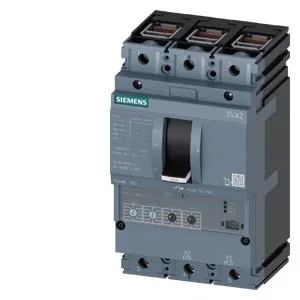
That flat thermal curve is unusual for an MCCB this compact; most competitors start rolling back above 50 °C. For a panel builder, that means you can dial in selectivity with downstream breakers without swapping the whole device. Breaking capacity is the headline number here: 242 kA at 240 V, 187 kA at 415 V and 440 V, 121 kA at 500 V, and 3.7 kA at 690 V. At 690 V the capacity drops to 3.7 kA, which still handles most motor branch circuits at that voltage level. Power loss is 0.6 W maximum, negligible for thermal budgeting inside a crowded panel.
Integration notes — what the trip unit and options mean
The ETU350 electronic trip unit supports adjustable overload protection (Ir), short-time delay (Isd), and instantaneous (Ii) settings, plus ground-fault alarm or trip if the optional module is fitted — this base version ships without ground-fault monitoring. There is no undervoltage release, no voltage trigger, and no communication function built in, so it is a standalone breaker for line protection. The product extension for a motor drive is listed as optional, meaning the breaker frame accepts a rotary-handle or motor-operated mechanism accessory if remote switching is needed later. No trip indicator on the front; fault indication is through the handle position only.