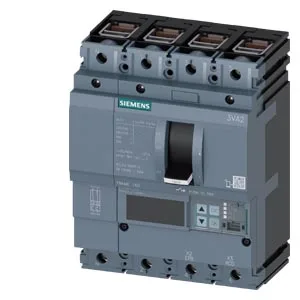
Its interrupting capacity reaches 242 kA at 240 V, dropping to 187 kA at 415 V and 440 V, then to 121 kA at 500 V, and 3.7 kA at 690 V — the 690 V figure is the one to watch if you're feeding a 690 V bus; that's a steep derating curve that governs selectivity coordination at higher voltages.
The 4-pole configuration (switching all three phases plus neutral) is the right choice for TN-S or TT systems where you need to break the neutral to ensure isolation. Ground-fault monitoring uses summation current formation on L + N conductors, so it detects residual currents without a separate GFCI module — that saves a DIN slot.
Panel integration dimensions
The 86 mm depth (3.39 in) is shallow enough for standard 200 mm deep enclosures, leaving room for wiring gutters and busbar connections behind the breaker. The 140 mm width (5.51 in) for a 4-pole MCCB is typical — verify your DIN-rail or mounting-plate spacing allows for the 4-pole width plus side clearance for cable bending radius.